
Guide for Texas owners
Texas owners: what a majority recap means under Texas rules
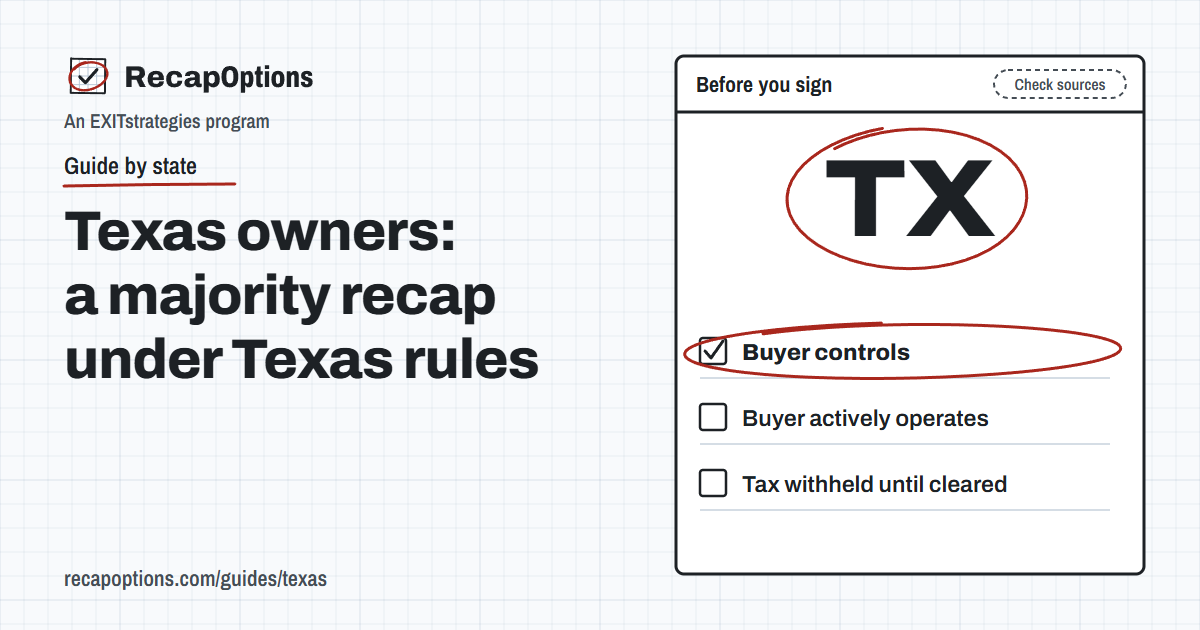
If you own a service business in Texas and a buyer has floated a "recap", two Texas rules are worth knowing before you talk price: how the state's securities rule treats a deal where the buyer takes control, and what the Comptroller expects when a business changes hands.
This guide explains; it does not advise. Nothing here is tax, legal, accounting or investment advice. Talk to your CPA and attorney.
Texas draws its line at control and an active buyer
Texas has a specific rule for merger and acquisition intermediaries. It describes a qualifying transaction as a transfer of "ownership and control" of a privately held company, and it requires that after closing "the buyer or group of buyers must actively operate the company" (7 Tex. Admin. Code 139.27). Control is presumed when the buyer can vote, or direct the sale of, 25% or more of a class of voting securities.
That matches the shape of a majority recap: a buyer who controls and runs the business, with you keeping a minority stake. It does not match a passive investor buying a small piece. That is the reason we advise on full sales and majority recaps and treat minority investments as education only.
Education only. We do not arrange minority investments, growth-capital raises or other securities offerings. If one may fit your goals, we can refer you to a registered broker-dealer.
The Comptroller wants its taxes cleared before the buyer pays in full
Texas Tax Code 111.020 says that when a person who owes state taxes sells the business or its stock of goods, the buyer "shall withhold an amount of the purchase price sufficient to pay the amount due" until the seller produces a Comptroller receipt or a certificate that nothing is due. A buyer who does not withhold can be liable up to the value of the purchase price (Texas Tax Code 111.020).
In practice, expect the buyer's counsel to ask for a certificate of no tax due, and plan time for it. If your sales tax or franchise tax filings are behind, fix them before a buyer finds them.
Most of the state tax steps below are written for the sale of a business or its assets. A majority recap is often structured as a sale of shares or units, and sometimes as an asset sale into a new company with rollover. Which steps apply depends on the structure. Your attorney and CPA decide.
Majority recap in one paragraph
A buyer acquires a controlling interest. You take most of the value in cash at closing and roll part of it, commonly 10% to 30% (Porte Brown), into the buyer's company. typical, varies Your role after closing is negotiated. When the buyer later sells the whole company, your stake is usually sold too, and that sale can pay more, less or nothing.
Read this first. Retained ownership and future upside are possibilities, not promised second paydays. Rolled or retained equity is usually illiquid, often a minority position behind acquisition debt, and can lose some or all of its value.
Questions Texas owners ask first
- Will my employees hear about this? We share identifying details with buyers only after they sign an NDA, and every buyer is screened before they see your name.
- How long does it take? Timelines vary with preparation and the market; many processes take months.
- Can I keep running it? In a majority recap the buyer gains control. Staying on as leader is often negotiated, not guaranteed.
Want an advisor to walk through your options with you?
Compare my options