
Guide for Pennsylvania owners
Selling part of a Pennsylvania company: a recap primer
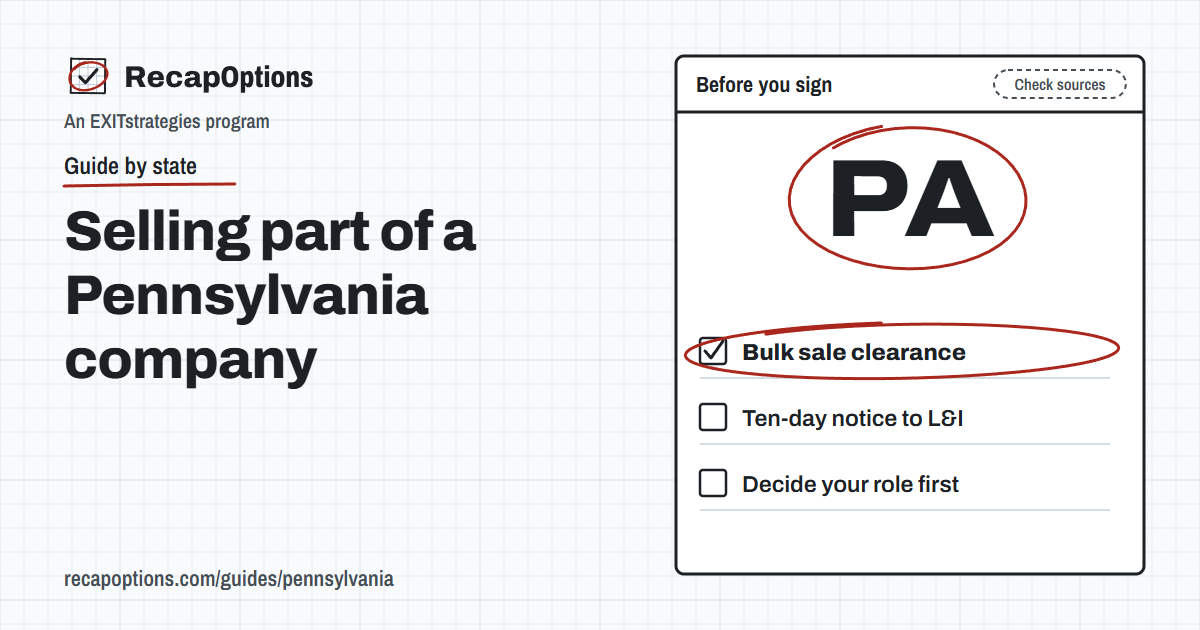
In Pennsylvania, selling most of a company's assets brings two state agencies into the timeline: the Department of Revenue and the Department of Labor and Industry. If a buyer has raised a recap, it helps to know when those steps apply and how the structure of the deal changes the picture.
This guide explains; it does not advise. Nothing here is tax, legal, accounting or investment advice. Talk to your CPA and attorney.
The bulk sale clearance from the Department of Revenue
Pennsylvania's Department of Revenue explains that its bulk sale rules apply when a business transfers more than 51 percent of its assets, and that the seller applies for a clearance certificate on form REV-181. The purpose, in the Department's words, is to ensure that "a purchaser does not unknowingly become liable for all of a seller's Pennsylvania tax liabilities" (Pennsylvania Department of Revenue, bulk sales).
A separate notice for unemployment compensation tax
The Department of Labor and Industry asks "any entity selling 51% or more of their assets" to give it a written ten-day notice of the sale, for unemployment compensation tax (Pennsylvania Department of Labor and Industry, bulk sale clearance). That is a second clearance, separate from the Revenue certificate. Ask your attorney who files each one and when.
Most of the state tax steps below are written for the sale of a business or its assets. A majority recap is often structured as a sale of shares or units, and sometimes as an asset sale into a new company with rollover. Which steps apply depends on the structure. Your attorney and CPA decide.
How control shapes the deal
Pennsylvania is one of the states listed by the International Business Brokers Association as having M&A-specific relief, through an M&A broker no-action letter dated January 25, 2016 (IBBA state list, rev. April 21, 2025). The federal rules for M&A brokers are built around a buyer who takes control and is active in management (15 U.S.C. 78o(b)(13)), which is the shape of a full sale or a majority recap. A minority investment is a different kind of transaction.
Education only. We do not arrange minority investments, growth-capital raises or other securities offerings. If one may fit your goals, we can refer you to a registered broker-dealer.
If you keep a stake
In a majority recap your rolled stake is commonly 10% to 30% (Porte Brown). typical, varies FBT Gibbons notes that most rollover equity can be repurchased if your employment ends (FBT Gibbons). Read the repurchase formula as carefully as the price.
Read this first. Retained ownership and future upside are possibilities, not promised second paydays. Rolled or retained equity is usually illiquid, often a minority position behind acquisition debt, and can lose some or all of its value.
A short checklist
- Confirm with your CPA whether your deal is an asset sale or an equity sale.
- If assets are moving, plan for the REV-181 clearance and the ten-day notice to Labor and Industry.
- Decide your role after closing before the term sheet does it for you.
- Keep "keep it and wait" on the list. Preparing now keeps every option open.
Want an advisor to walk through your options with you?
Compare my options