
Guide for Michigan owners
Michigan service owners: a full sale or a majority recap?
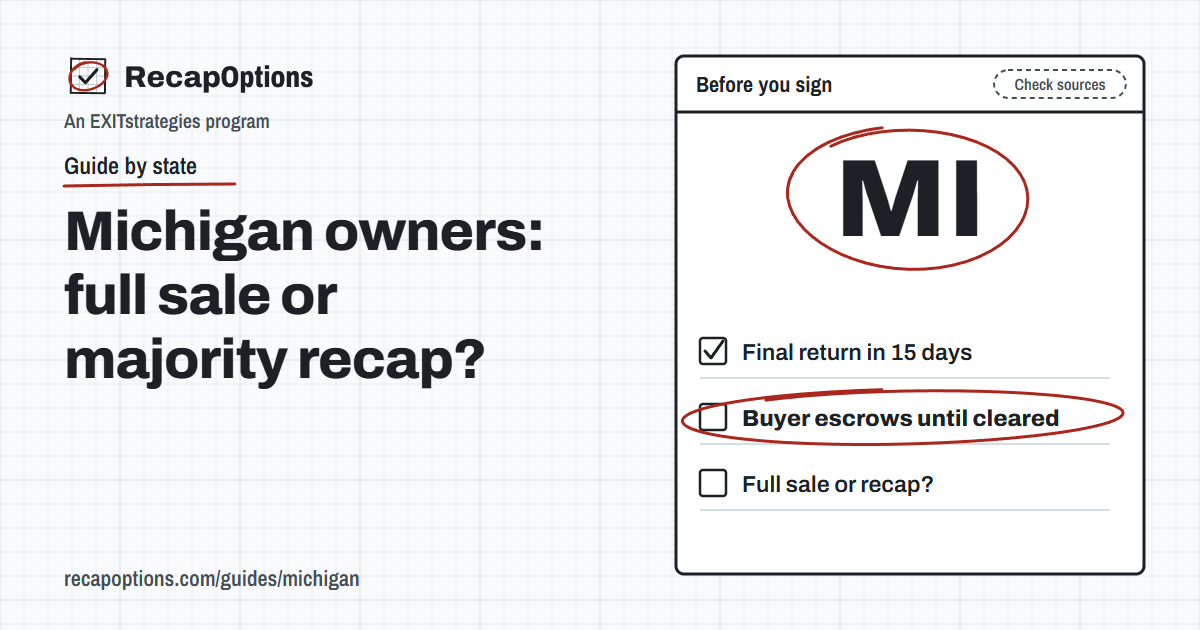
For Michigan owners, the choice between a full sale and a majority recap usually comes down to how much you want to keep: cash, control, a role and a stake in what comes next. The state's rules on tax clearance apply either way, so they are worth knowing early.
This guide explains; it does not advise. Nothing here is tax, legal, accounting or investment advice. Talk to your CPA and attorney.
Full sale and majority recap on the same rows
| Question | Full sale | Majority recap |
|---|---|---|
| Cash now | Most of the price at closing; part may be held back or paid later as an earnout. | Most of the value at closing; the rest stays invested as your rolled stake. |
| Ownership you keep | None. | A minority stake. |
| Who controls | The buyer, from closing. | The buyer. You keep negotiated rights, not control. |
| Later upside | None, apart from an earnout if agreed. | Possible. Your stake can be worth more, less or nothing. |
Read this first. Retained ownership and future upside are possibilities, not promised second paydays. Rolled or retained equity is usually illiquid, often a minority position behind acquisition debt, and can lose some or all of its value.
Michigan's final return and escrow rule
Michigan Compiled Laws 205.27a says that a person who sells or quits a business must make a final return within 15 days, and that the purchaser "shall escrow sufficient money to cover the amount of taxes, interest, and penalties" until the former owner produces a receipt from the State Treasurer or a certificate that no taxes are due. With the owner's written waiver of confidentiality, the Department of Treasury releases the business's known tax liability to the purchaser within 60 days of the request (Michigan Compiled Laws 205.27a).
That 60-day window is the practical point: if the buyer needs the Treasury's answer before closing, ask for it early.
Most of the state tax steps below are written for the sale of a business or its assets. A majority recap is often structured as a sale of shares or units, and sometimes as an asset sale into a new company with rollover. Which steps apply depends on the structure. Your attorney and CPA decide.
Michigan's M&A broker rule
Michigan is listed by the International Business Brokers Association as having adopted Rule 4.2, a merger and acquisition broker exemption, on July 3, 2019 (IBBA state list, rev. April 21, 2025). The federal rules for M&A brokers are built around a buyer who takes control and is active in management (15 U.S.C. 78o(b)(13)). Minority investments fall outside that shape.
Education only. We do not arrange minority investments, growth-capital raises or other securities offerings. If one may fit your goals, we can refer you to a registered broker-dealer.
Which fits you?
- A full sale fits owners who want to step out after a handover and take the most certainty at closing.
- A majority recap fits owners who want cash now and are comfortable keeping a riskier, illiquid stake under a buyer who controls.
- Keeping it and preparing fits owners who need to keep control. Waiting is a plan, not a default.
Want an advisor to walk through your options with you?
Compare my options