
RecapOptions blog
Minority or majority recap: the one question is control
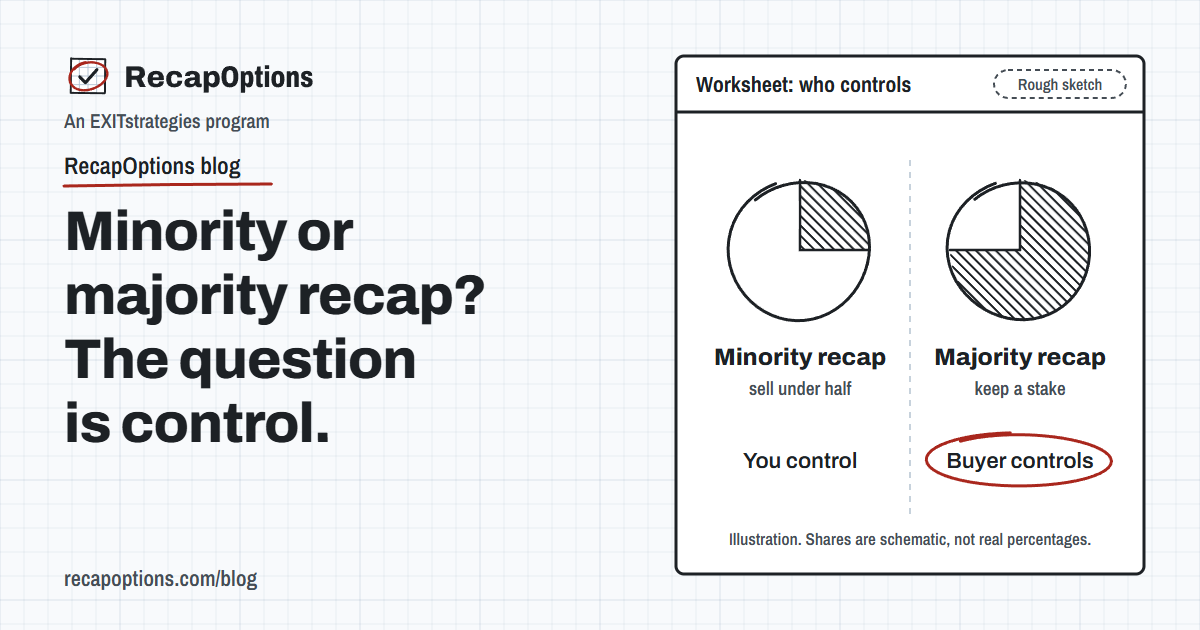
Two owners can both say they are "doing a recap" and mean opposite things. One keeps running the company with a new co-owner at the table. The other has sold control and now reports to a board. The word that separates them is control, and almost everything else follows from it: the cash you take, the debt the company carries, the role you keep and what any later upside is worth.
This guide lays the two side by side on the same rows, the way the full comparison on our homepage does for all seven options. It explains; it does not recommend. Nothing here is tax, legal, accounting or investment advice. Talk to your CPA and attorney.
First, what "recap" means
A recapitalization changes who owns and funds the company. For an owner it usually means selling part of the equity, often with some new debt alongside. Main Street Capital describes the two flavours in plain terms: in a minority recap you "retain ownership control", while in a majority recap "ownership control transfers to new majority owner" (Main Street Capital).
Minority recap: you sell less than half and keep control
Main Street defines a minority recapitalization as "the sale of 1% - 49% of a company" and notes that debt is typically used alongside the minority equity to provide more liquidity (Main Street Capital). You keep control of the company, but you now have a co-owner who will usually want agreed rights: information, a say on big decisions and, eventually, a way to sell their stake.
What it can give you: some cash for the shares you sell, your seat at the head of the table, and a partner with capital or experience. What it costs you: a share of future value, new reporting duties, and often new debt on the company that has to be paid before owners see anything.
Education only. We do not arrange minority investments, growth-capital raises or other securities offerings. If one may fit your goals, we can refer you to a registered broker-dealer.
Majority recap: you sell control and keep a stake
In a majority recap a buyer, often a private equity group, acquires a controlling interest and you roll part of your value into the new ownership. The rolled stake is commonly described as 10% to 30% of the deal, though it varies with the buyer and how the percentage is measured (Porte Brown). typical, varies
Because the buyer controls, your role is whatever you negotiate: keep leading, move to the board or step back. FBT Gibbons notes that rollover owners may have board representation depending on the size of their holding, and that "most rollover equity is subject to repurchase rights upon termination of employment" (FBT Gibbons). In plain words: if you leave the company, it can often buy your stake back on a formula you agreed at the start.
The later sale matters most here. When the buyer eventually sells the whole company, your rolled stake is usually sold too. That sale can pay more, less or nothing. Hold periods have lengthened: Private Equity Info measured a typical hold of 6.0 years across 13,757 exits from 2021 to mid-2026 (Private Equity Info). typical, varies
Read this first. Retained ownership and future upside are possibilities, not promised second paydays. Rolled or retained equity is usually illiquid, often a minority position behind acquisition debt, and can lose some or all of its value.
Federal law also gives a rollover seller a right to information before signing. If you are offered securities, such as rollover equity in the buyer, the rules for M&A brokers require that you receive the issuer's most recent year-end financial statements, a balance sheet dated not more than 120 days before the offer, and information on management, operations and material loss contingencies (15 U.S.C. 78o(b)(13)). Ask for it, read it with your CPA, and ask what class of equity you are getting.
The same rows, side by side
| Question | Minority recap | Majority recap |
|---|---|---|
| Cash now | Some, for the shares you sell (under half). | Most of the value at closing; the rest stays invested as your rolled stake. |
| Who controls | Usually you, with investor rights agreed up front. | The buyer. You keep negotiated rights, not control. |
| Your role | You keep leading, with a co-owner to answer to. | Negotiated: lead, join the board or step back. |
| Debt on the company | Often used alongside the sale (Main Street, linked above). | Often new acquisition debt, paid before your stake. |
| Later upside | Possible, shared with an investor who will want a way out. | Possible. Your stake can be worth more, less or nothing at a later sale. |
| Where we fit | Education only. We can refer you to a registered broker-dealer. | We advise on majority recaps. |
Where the legal line on "control" sits
Control is not just a feeling about who is in charge. Under the federal M&A broker rules, control means the power to direct management or policies, and it is presumed when someone can vote, or direct the sale of, 25% or more of a class of voting securities (15 U.S.C. 78o(b)(13)). That is one reason a deal where a buyer takes control and runs the business is treated differently from a passive investment. For an owner, the practical point is simple: the percentage on the term sheet is only part of the story. The board seats, vetoes and consent rights in the documents decide who really steers.
Three questions that usually decide it
- Do you need to keep control? If yes, a majority recap is off the table by definition, and waiting or preparing may matter more than any deal.
- How much cash do you want now, and how much risk can you leave in? A majority recap pays more at closing and leaves a smaller, riskier stake. A minority sale pays less now and leaves you with most of the risk and most of the say.
- What role do you want in three years? If the honest answer is "less", a buyer who controls and has a plan for your successor may fit better than a co-owner who expects you to keep leading.
Our four-question chooser marks which options deserve a closer look for your answers, and keeps "Keep it and wait" on the sheet every time.
Taxes: ask before you sign anything
Tax treatment depends on deal structure and your situation. Some structures may defer tax on a rolled portion; others do not. Your CPA or tax attorney decides. Our companion post lists the questions to take to your CPA before a partial sale.
Want an advisor to walk through your options with you?
Compare my options