
RecapOptions blog
Questions to ask your CPA before a partial sale
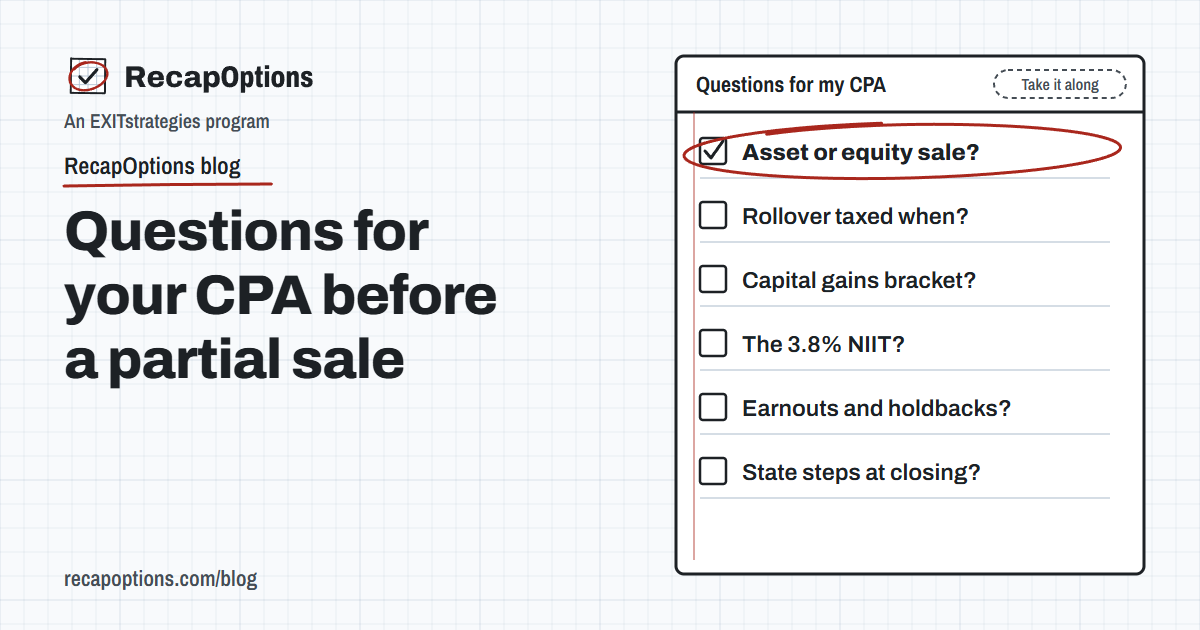
"My CPA will tell me" is a good instinct. The trouble is timing. By the time a letter of intent is signed, the structure that drives most of the tax result is usually set. The best time to ask is before you talk price, and the best way to ask is with a short, specific list.
Here is that list. Each question says why it matters and links to the primary source where one exists. None of it is advice. Nothing here is tax, legal, accounting or investment advice. Talk to your CPA and attorney.
1. Would this be an asset sale or a sale of shares or units?
This is the question that shapes every other answer. In an asset sale the buyer buys the company's assets; in an equity sale the buyer buys your shares or membership units. The IRS says both the seller and the purchaser of a group of assets that makes up a trade or business must report the sale on Form 8594 when goodwill or going-concern value attaches, or could attach, to the assets (IRS, About Form 8594). That form allocates the price across asset classes, and the allocation affects how your gain is taxed. Ask your CPA how each structure would be taxed for your entity type.
2. If I roll part of my value into the buyer, could that part be tax-deferred?
In a majority recap you often keep a stake by rolling part of your value into the buyer's company. Some structures may defer tax on the rolled portion; others do not. It depends on how the rollover is built and on your entity. Ask your CPA to explain the options before the term sheet fixes them.
Read this first. Retained ownership and future upside are possibilities, not promised second paydays. Rolled or retained equity is usually illiquid, often a minority position behind acquisition debt, and can lose some or all of its value.
3. Which capital gains rate would apply to my gain?
The IRS explains that net capital gains are taxed at 0%, 15% or 20% depending on taxable income, with a few exceptions taxed at higher rates (IRS Topic 409). A large one-time gain can push you into the top bracket for that year. Ask what your bracket would be in the year of closing, and whether spreading proceeds over years would change it.
4. Will the 3.8% net investment income tax apply?
The IRS describes a 3.8% net investment income tax on individuals whose modified adjusted gross income passes set thresholds: $250,000 for married filing jointly and $200,000 for single filers (IRS Topic 559). Whether gain from selling an active business counts as net investment income depends on your facts. Ask.
5. How are earnouts, escrows and holdbacks taxed, and when?
An earnout is "contingent additional purchase price based on the company's post-closing performance" (Schwabe). Escrows and holdbacks hold back part of the price at closing to cover your promises. All three change when you receive money and how much you finally receive. Ask how each would be reported, in which year, and what happens if a target is missed.
6. What would the buyer's adjustments do to my numbers?
Buyers rebuild your earnings to their own definition. Owner pay, one-time costs and family payroll are all adjusted. Ask your CPA which of your add-backs are documented well enough to survive a buyer's review, and which are not. This is the cheapest preparation you can do.
7. Could an ESOP apply to us?
An ESOP is a trust that buys shares for employees. A seller can defer capital gains tax only under conditions, including that the company is a C corporation and the ESOP owns at least 30% (NCEO). If you are an S corporation or an LLC, ask whether that matters for you. ESOPs are set up with specialist advisers.
8. What should I ask for before I take rolled equity?
If you are offered securities as part of the deal, federal rules for M&A brokers require that you receive the issuer's latest year-end financial statements, a balance sheet dated not more than 120 days before the offer, and information on management, operations and material loss contingencies (15 U.S.C. 78o(b)(13)). Ask your CPA to read those with you, and to explain where your class of equity sits in the payout order.
9. Are there state steps that affect the closing?
Several states make a buyer withhold part of the price, or file a notice, until the seller's state taxes are cleared. Texas, Ohio, Illinois, Pennsylvania and Michigan all have rules of this kind. Which ones apply depends on the structure. Ask your CPA and attorney which apply to your deal and how long they take.
Our recap guides by state list the rules for Texas, Ohio, Illinois, Pennsylvania and Michigan, each with its source.
10. What does doing nothing for three years cost or save me?
Waiting is a plan, not a default. Ask your CPA what preparing now (cleaner books, a documented successor, a tidy entity structure) would change, and whether any planning needs years to take effect. Keeping the company is always one of the options on our comparison.
Take the list with you
The worksheet on our homepage turns your answers into a summary you can paste into an email to your CPA, with these questions included. If you would like an advisor to walk through it with you first, send us your answers. The first conversation costs nothing, and submitting does not commit you to anything.
Want an advisor to walk through your options with you?
Compare my options